Riding the Silk Road, 2002-2009)

Riding the Silk Road, 2002-2009)
Where it all began: Xian, May 2002

Friday, July 08, 2005

Silk Road Ride, 2004: Part 1 (Urumqi-Shawan)


Shawan, China, km 185.

Hello Everyone:

Greetings from the road! I am in a dinky little town a day and a half's ride west of Urumqi on my second attempt to ride across Central Asia. It feels good mentally to be back in the saddle and exploring the world, but physically, it's a different story.

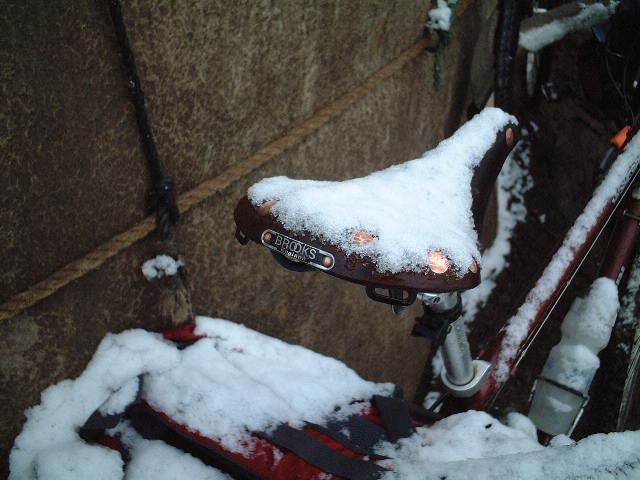
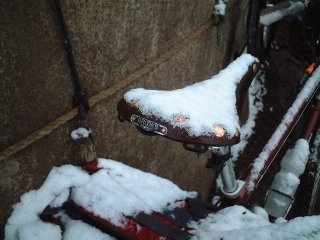
My diary entry for yesterday, the first day of cycling out of Urumqi, begins "OUCH!" I put in a biggish day, 135 km, but it was flat, I had a tailwind (those of you who are cyclists know how rare that is!) and I was excited. I seem to have overdone things a bit. Last night I had a sore tush (no surprise there, especially with my hard leather Brooks saddle; comfy in the long run, a bit tenderizing at first), sore Achilles tendons (the bane of my cycling existence), a sunburn (only on the bits of flesh I missed, like the inside of my elbows) and tender knees.

Today, I awoke to grey skies which turned to rain as I rode out of Manas, where I had spent the night. I rode for a couple of hours through cold rain and strong headwinds and stopped for a late breakfast around 50 km down the road. When I got up from scarfing down some great noodles, I realized something was very wrong with my knees. I had progressed from a slight stiffness to swelling and an inability to bend my legs more than 45 degrees from the vertical. I could barely get on the bike, and the first few pedal strokes brought tears to my eyes. I decided that it would be unwise to ride further today, since I didn't want to destroy my body this early in the trip, and rode off very, very slowly in search of the nearest hotel. (You can pick yourselves off the floor now; I do listen to the warning signs from my body occasionally, even if it doesn't seem like it.) I spent the afternoon snoozing, and even popped some of my leftover anti-inflammatory pills. I will see how the knees feel tomorrow morning, and I may take another day off the bike if they don't feel back to normal.
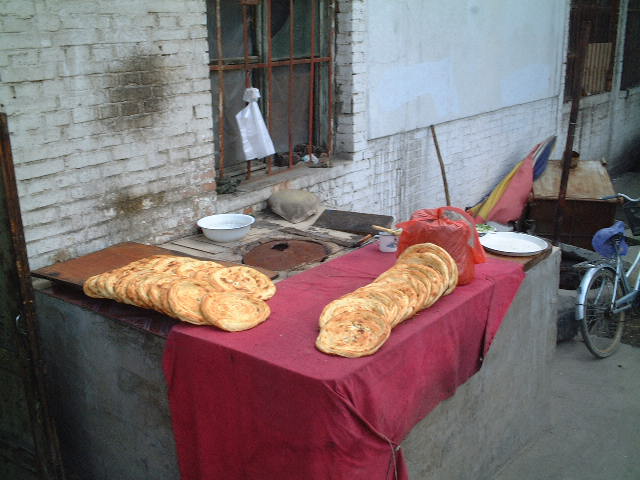
I have to confess that I'm feeling annoyed at my body. Although I'm only two years older than I was on my ill-fated last bike trip, I feel about twenty years older. The rheumatic fever really knocked me for a loop, and I haven't been back doing the sorts of things I used to do, except in small, sad weekend-warrior doses. I hope that this is just my body reacting to going from zero to full throttle with no warning, rather than a sign that the rheumatic fever is lurking in the wings. That would be rather disappointing!

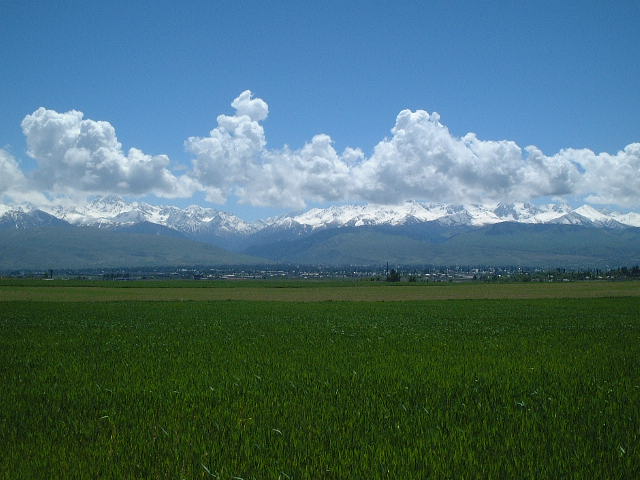
It feels good to be back in China, although the scenery so far has been pretty nondescript. It's been rainy for 2 of the first 3 days here, and even yesterday, while it was sunny, I had only intermittent views of the Tien Shan mountains through the dust haze, pollution and clouds. I know that there are snow-capped 6000-metre mountains just to the south, but I can barely make out the foothills. I'm taking the pansy route at first, keeping north of the mountains in the plains for the first 600 km until I hit the Kazakh border. Then I'll cut into the mountains and I hope to get close enough to Pik Pobedy and Khan Tengri, the two highest peaks in the range, to get a good look at them. (If it isn't still raining, that is.) Then in Kyrgyzstan I hope to spend the entire time playing in the mountains before riding south into Tajikistan and the Pamirs. This assumes, of course, that the knees and Achilles tendons recover from this attack of middle-agedness enough to allow me to do so.

I've been riding through endless farm fields so far, irrigated by runoff from the Tien Shan. The farms are punctuated by huge, ugly industrial cities, with bricks, cement, tomatoes and electric power the main products so far. I'm surprised how Chinese this area is. That may sound like a ridiculous statement, seeing as I am in China, but Xinjiang, the westernmost province in which I'm riding at the moment, has historically not been very Chinese. Instead, various Turkic and Mongol tribes have dominated the region for centuries. The Chinese have engaged on a vigourous settlement policy for the past few decades, however, as they have in Tibet and Inner Mongolia, trying to tie these restive regions more firmly to the Motherland, and the area I'm riding through seems to have been one of the main settlement areas. I suspect that most of this area was given over to grazing by huge flocks of sheep until the Chinese put it to the plow and settled Chinese farmers on it. It will be interesting to see how the ethnic makeup changes as I near Kazakhstan.

I was addressed in Russian for the first time today, by an Uzbek guy in a restaurant. He ran out of Russian words before I did, but it was still a funny experience to be a Canadian sitting in an ethnic Kazakh restaurant speaking broken Russian with an ethnic Uzbek in a province in China. Globalization, anyone?

Anyway, off to bed. To sleep, perchance to heal; aye, there's the rub. I hope I wake up able to walk normally!

Hope everyone's well and enjoying life to the fullest!

Graydon


Silk Road Ride, 2004: Part 2 (Shawan-Khorgas)

Zai Qian China, Privyet Kazakhstan!

Khorgas, China, May 6, 2004:

It's my last night in China for this trip and maybe forever. I had a huge day of downhills and tailwinds to get here unexpectedly early, so tomorrow I will enter Kazakhstan, my first new country in almost three years. I'm quite excited, although it will be sad to say goodbye to a country that I've biked over 11,000 km through over the course of four trips.

So, first off, the knees are better. Not 100 percent, and they complain from time to time, but no more swelling and inability to walk. I took an extra day off back in Shawan and then did a couple of gentle days to get tuned up for riding again. I think that as long as I don't try to be Lance Armstrong, I should be fine. My whole body is slowly getting into cycling shape, I think: the legs are feeling stronger, the Achilles tendons are better, and my butt is no longer quite as tender.

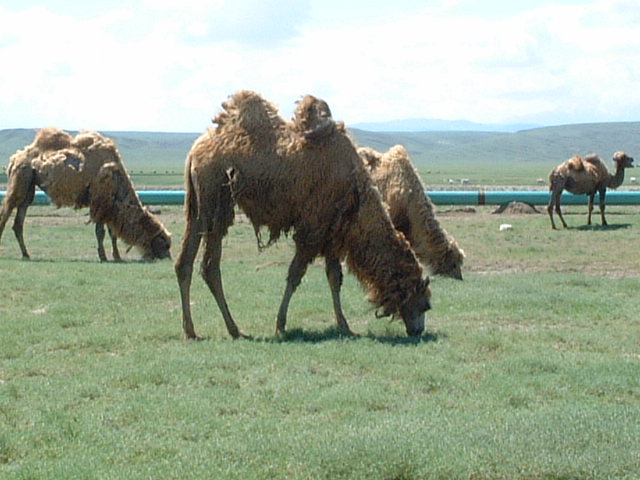
The ride from Shawan here took me through increasingly arid steppe which eventually became real desert, sand dunes, camels and all. The road, which had been really, really good all the way from Xian (two years ago) suddenly went straight down the drain at the town of Wusu, the beer-brewing capital of Xinjiang. They're building a new road from Wusu to here, and it's only about half done, which means that there's about 200 km of torn-up road to navigate in the middle. Rather than build the new road next to the old one and let traffic drive on the old road, most of the way the old road has been ripped up, leaving a Calvary of boulders, dirt, mud and bits of asphalt to navigate. In the heat and dust, this is not pleasant. It's not the worst roads I've seen in China (the road to Mt. Kailash in Western Tibet is far worse, and the 300 km of cobblestones I rode in Yunnan was more painful on the backside), but it was a harsh surprise. ! ; I've been on the new road since yesterday, and I certainly appreciate the luxury of smooth pavement far more now. It's funny; my cycling acquaintance Dale Myers, who rode this route 2 years ago, told me about how horrible the road from Wusu to Urumqi was back then, and I had a good laugh at his expense as I rode on brand-new divided highway where he had bumped along a construction site. I guess Dale's having the last laugh now.

Anyway, after days of parallelling the Tien Shan and slowly making out more and more of their snow-capped peaks through the haze and the clouds of choking dust along the road, I turned south yesterday and headed up into the mountains. The Tien Shan is quite a broad mountain chain, with three main parallel ranges, and I was crossing the northernmost range. The road uphill was arrow-straight, newly paved and through a bone-dry desert.

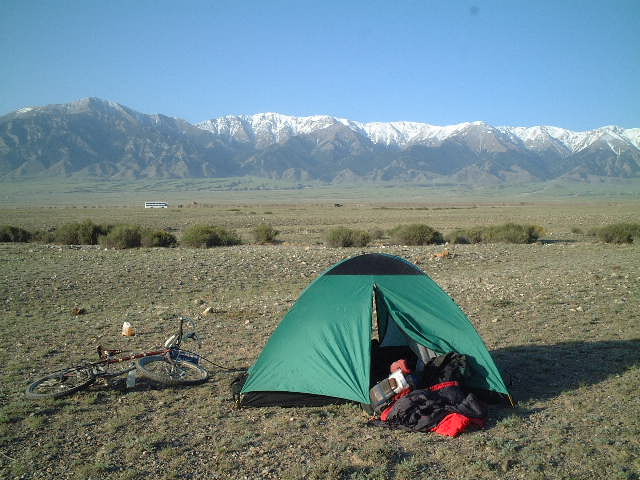
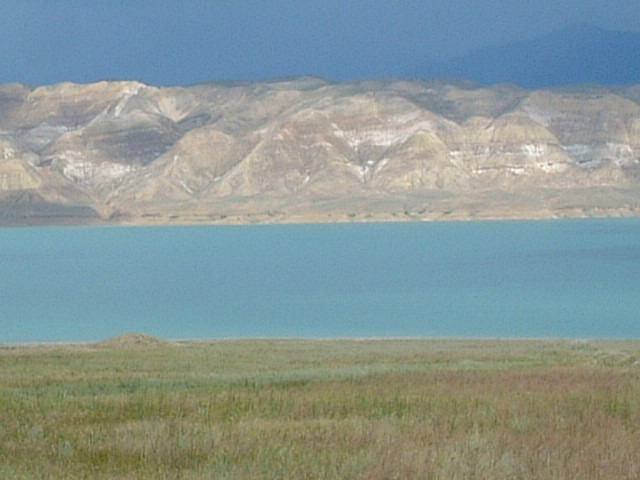
I camped halfway to the top yesterday and set off this morning planning to get to the top of the climb (2100 metres above sea level) and spend the rest of the day relaxing beside the lake up there. I did indeed spend the morning climbing relentlessly under a hot sun to the crest of the pass, and the lake was quite pretty (although not nearly as spectacular as Karakul Lake or Namtso, from earlier Chinese bike trips), with snow-capped Tien Shan peaks behind a white-capped blue jewel of a lake. It was those whitecaps that were a problem; I wanted to camp but my tent would not have stood up to the gale-force winds raking the lake. I was blown around the lake at 25 km/h without the bother of having to pedal.

I stopped for lunch at the far end of the lake, and then set off down the other side expecting another desert descent. Instead I found myself in Switzerland: emerald green steep alpine pastures interspersed with spruce forests and jagged peaks high, high above. If this is what the Tien Shan will be like in Kyrgyzstan, then I'm really looking forward to it. It was an exhilirating descent, made more so by the tailwinds which had strengthened as they were funneled down the valley. I got to use my new zillion-dollar drum brake for the first time to slow my descent; it certainly beats burning my rims out by riding my normal brakes. Even with numerous photo stops (I took as many photos today as I had taken the whole way from Urumqi; I think I like mountains), it took very little time to fly down to the lowlands on the other side, dodging clouds of bees from the plethora of beekeepers lining the road.

Once I was in the lowlands, the winds got even stronger, with the poplar trees lining the roads and fields bent nearly double by the hurricane. I was still going slightly downhill, but the main factor in my speed was the fact that the wind was squarely in my back. I rocketed along at 50 km/h, occasionally having to brake when the wind got me going too quickly. I ate up the kilometres so quickly that I realized it would be silly to waste such a memorable wind by stopping short of the border. I shot out into the plains and still kept going at a decent 35 km/h without pedalling. The wind finally turned against me 2 km from Khorgas, but by that point it had done its work. Those of you who followed my first attempt to ride the Silk Road two years ago will remember that headwinds nearly killed me twice on that trip; I think that this is a sort of apology from the weather gods, and it's one that I gladly accept!

So tomorrow I hit Kazakhstan; I should only be there for three days, cutting across a tiny corner to neighbouring Kyrgyzstan, but with road conditions and winds playing such a role in determining how far I get in a day, it might take a bit longer than I plan. Then I'll cross into Kyrgyzstan and make my way to Karakol and maybe do some hiking near the highest peaks in the Tien Shan, Pik Pobedy and Khan Tengri. I should be back in e-mail contact there in Karakol. Until then, zai qian and have fun!

Cheers

Graydon


Silk Road Ride, 2004: Part 3 (In Karakol)


Hello Everyone:

I'm two countries along from where I last wrote; I've nipped across a tiny bit of Kazakhstan and bumped downhill to the little tourist town of Karakol (formerly Przhevalsk, if you've got an older map), on the shores of Lake Issyk Kul in Kyrgyzstan. Since it was a tough slog getting here, and since the weather forecast is for lots of rain, and since it's a pleasant enough little town, I've decided to take a couple of rest days here and catch up on sleep, correspondence and my Russian study.

I last wrote late at night from the Chinese-Kazakh border town of Khorgos, 4824 kilometres by road from Beijing and 4238 kilometres from my original starting point in Xian in 2002. The next day I ran around trying to buy things I needed, like a bigger monkey wrench and a new lock, before heading to the border. I wasted a lot of time looking for somewhere to change money in town; I finally gave up and when I pulled up to the customs shed, a posse of moneychangers descended on me waving sheaves of Kazakh tenge and offering poor rates. After a bit of haggling, I accepted my stack of new money and headed through customs. I had anticipated the Kazakh customs officials being officious and sticky-fingered, but they barely glanced at me or my luggage; the Chinese were much more thorough, having me pass all my luggage through X-ray machines. I had to load my bike into a van for the short ride across no-man's land, still marked by barbed wire and landmines; in the 1950s and 1960s, this border area saw occasional artillery duels, and it's still heavily guarded. After lots of waiting in line, suddenly I was at liberty in Kazakhstan.
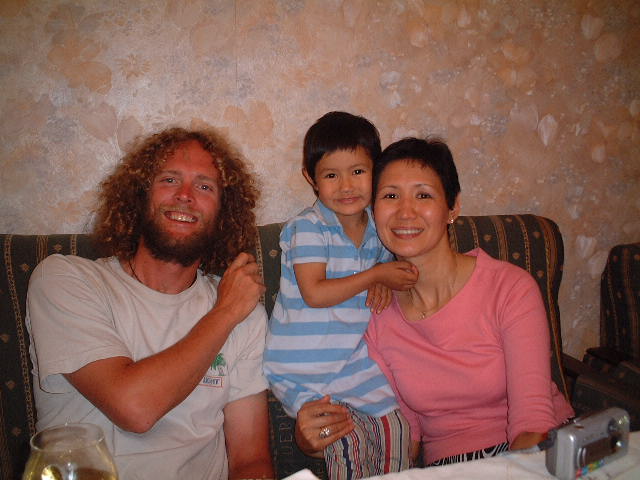
As I rode towards the first town in Kazakhstan, still being blown by the tailwinds of the previous day, I looked around to see what was different on this side of the border. For one thing, the countryside seemed much less densely populated; whereas on the Chinese side most of the land was irrigated agricultural fields, on the Kazakh side it was rangeland for flocks of sheep and herds of cows. The pencil-thin Lombardy poplars that had lined much of the road through China gave way to shorter, squatter trees, and the vehicles were suddenly all old Russian Ladas or newer European Audis. The trucks were mostly old European transports with their German or Dutch company markings still on them.

Zharkent, where I spent the night, was a very European-feeling town after China. Every house had a picket fence around it enclosing a little garden, and the regular city blocks, shaded by tall trees, felt a little like Thunder Bay. I tried to register with the local police, but after 45 minutes of being bumped around and ignored by various Kafkaesque bureaucrats, I was told that I didn't have to register anymore. This is apparently not true, but I think the bureaucrat in question just couldn't be bothered. I found a cheap hotel and set off to find a decent roadmap of Kazakhstan. Even though I was helped in my quest by a young ice cream vendor, it was a fruitless search; apparently no-one in Zharkent really needs maps. I had fun anyway, though, practicing the Russian that I studied so many years ago. I found that it was much easier talking to Kazakhs than it had been talking to Chinese people, and it was nice to feel a bit more part of a society rather than a freakish outcast.

The next day I set off with the dawn through a pretty forest and then struck off south across the open steppe. Much of the land was marshy, and was alive with birds of various sorts; I wished that I had a bird book with me. After 60 kilometres, I stopped in a small town and realized how different Kazakhstan was from China. Whereas in China the tiniest hamlet will have several food stores and a few restaurants, here it took me forever to find the one shop in town. I asked for bread. "Nyet." Cheese? "Nyet" Apples? "Nyet." What did they have? Chocolate bars, hideous cookies and lots and lots of vodka. The ladies who ran the shop were friendly enough and so were the schoolgirls who came in to buy candy and stayed to chat with the foreigner, but it didn't do much to assuage my hunger.

Further down the road, in the larger town of Shonzhy, Malik, a cafe owner, beckoned me in off the street. He plied me with tea and the best noodles I've had since China, and fetched his daughter Rina who wanted to practice her English. It was much more fun chatting with the family than sweating my way through 35 degree heat, so I sat and talked to them about Canada and how Rina could get to study English there. Malik described a perfect camping place for that evening, and refused all talk of payment when it came time for me to settle the bill. I rode out of town in the late afternoon and was rudely surprised to find that the road was no longer across a level plain, but instead climbed relentlessly towards the mountains across a near-desert. Just as I was despairing of finding a place to spend the night, the road disappeared into a deep canyon and I found the perfect campsite that Malik had described. On my way to a grassy riverside meadow a family of shepherds invited me in for tea, bread, cheese and sour cream. It was fun sitting there trying to express myself in Russian. Only one of the family really spoke good Russian, so he played Kazakh-Russian interpreter. Finally I tore myself away, set up my tent and fell asleep to the sound of rushing water and croaking frogs.

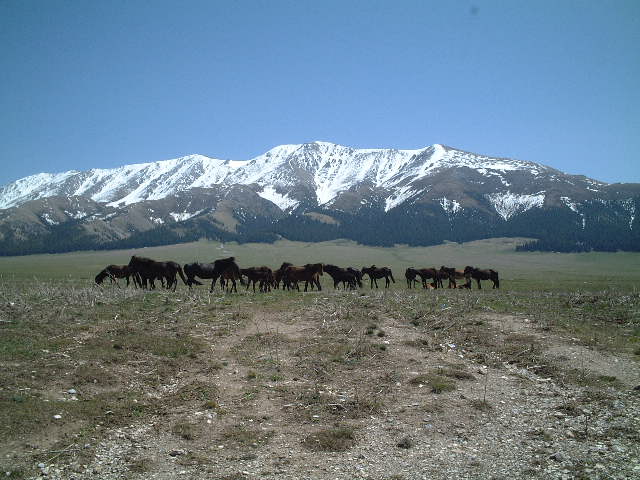
In the morning, I found that I had an even steeper climb ahead of me. For 21 kilometres I toiled uphill at 6 km/h, wondering, as the altimeter ticked towards 2000 metres, how high the border crossing into Kyrgyzstan was going to be. Without a decent map, it was hard to tell what lay ahead of me. I was pleasantly surprised, then, to reach the crest of the pass some 40 kilometres from the border and find an emerald-green plateau flecked with horses and sheep in front of me. I zipped into the town of Kegen, stocked up on groceries and rode off towards the Kyrgyz border. As the road neared the border, it deteriorated into something resembling a back alley, and I wondered if I had missed a turn somewhere. Instead I came around a corner and found, in front of me, a pair of shacks that marked the international border. Half a dozen Kazakh soldiers in the throes of terminal boredom clustered around to check out my bike and ask questions about my trip. On the other side, a single Kyrgyz soldier checked me in in about ten seconds, and there I was, entering my 60th country.

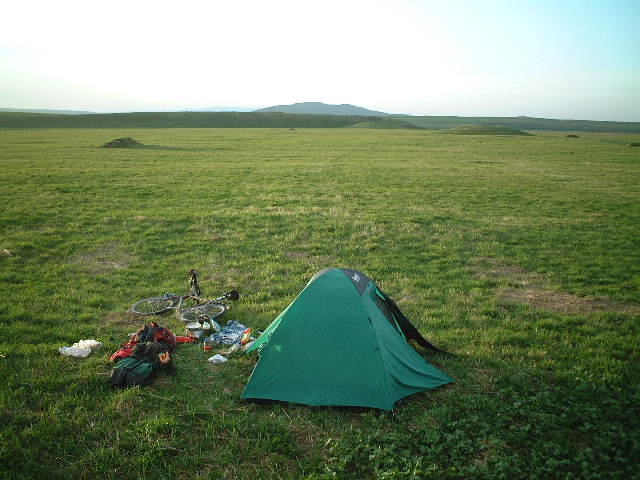
The Karkara valley, across which the border was drawn arbitrarily, is one of the historic crossing points of the Tien Shan. It's only 2100 metres in elevation at its highest point, and countless armies and migrating tribes have used it as a highway between the steppe to the north and Lake Issyk Kul to the south. The Scythians, mentioned by Herodotus in 500 BC and who recur in history for 10 centuries after that, left their mark in the form of a series of burial mounds that jut up from the flat valley floor. I camped beside one of them and watched the last rays of the sun lighting up the rest of these royal tombs.

Yesterday morning I set off under menacing skies with Karakol as my destination. The valley floor was so flat and marshy that it was hard to tell exactly where the top of the pass was; I had to keep checking the direction of flow of water to see whether I was going uphill or down. Muskrats frolicked in the stream while eagles and black cranes circled lazily overhead. The ratio of horses to Kyrgyz seemed to be about 100 to 1, and I barely saw a single human, no matter how young, who wasn't mounted on horseback. I recalled that some theories of the origin of the Kyrgyz people had them as descendants of Genghis Khan's hordes, and they looked the part, with their high cheekbones giving them a Mongol or Tibetan appearance. Another great conqueror and fan of raping and pillaging, Tamerlane, is said to have passed this way and left a pile of rocks as a memorial to his battle dead, although it looks rather more like a pile of rocks stripped from the lining of a nearby burial chamber.

At this point the menace of the skies was borne out in the form of rainshowers and I put raincovers on my panniers and a raincape and rainpants on myself and settled in for a long, wet ride. It rained intermittently most of the way down the long, flat, agricultural valley, filled with farmers out planting potatoes, and then the heavens opened in a torrential downpour that lasted for the next 45 kilometres. There were more horse-drawn carts on the road than cars, and the men all sported the white felt Kyrgyz national hats, but there was no chance to snap any photos. I was invited to shelter at a gas station, where the obligatory tea and bread helped warm me up, but eventually I had to face the inevitable and head back out into the storm. By the time I reached here I was tired and cold and the final uphill into town was a cruel blow. I found the local backpacker hangout, Camp Turkestan, and settled in for a sound night's sleep in my own personal yurt.

I'm really enjoying the Central Asian republics so far; I find the people friendlier and easier to talk to than in China. It's partly that my Russian is better than my Chinese, but also, I think, a more European mindset that makes for easier communication. Food is a bit less satisfying and more expensive here, but so far the friendliness of the people makes up for that. The ethnic diversity here is striking; Kazakhstan featured lots of Uyghurs (the Turkic people who are the largest ethnic group in Xinjiang province), plenty of Russians and Kazakhs and a few Kyrgyz, all within a tiny corner of the country. I feel a bit bad that I speak to everyone in Russian, the language of the imperial oppressor, but it beats trying to speak a different language in each country. Although Kazakh, Kyrgyz and Uyghur (as well as Uzbek) look pretty similar to me when I compare them in my Lonely Planet phrasebook section (they're all Turkic languages), the locals I talk to say that they're not really similar enough to understand well, so that when Kazakhs speak to Kyrgyz, they usually use Russian.

So now I'm contemplating what to do next. I had hoped to go hiking for a few days into the mountains to see Pik Pobeda (Victory Peak) and Khan Tengri (Lord of the Heavens), the two highest peaks in the Tien Shan, and I shelled out money for a border zone permit to do just that. Looking at the weather forecast, though, it looks like rain from now until June, so I'm not sure I want to go walking in the rain in return for views of clouds. I'll make up my mind tomorrow what to do. I have to head eventually to Bishkek to pick up visas for Uzbekistan and Tajikistan, my next two countries, and then I'll bike south towards Osh and the Tajik border.

Hope that everyone is well and enjoying themselves; I certainly am!

Cheers

Graydon


Silk Road Ride, 2004: Part 4 (Difficult? No, Bish of Kek!)


Saturday, May 29, Bishkek, Kyrgyzstan

I'm sitting here at the first really good Internet cafe I've seen since China, one where it doesn't take 20 minutes to log into Yahoo. Bishkek is a leafy, relaxed city that feels more like civilization than anywhere else I've been yet on this trip. I'm here tackling the fearsome bureaucratic hassles of visas and permits which bedevil Central Asian travel, and so far the struggle has been going my way, which makes me wonder what disasters may yet await.

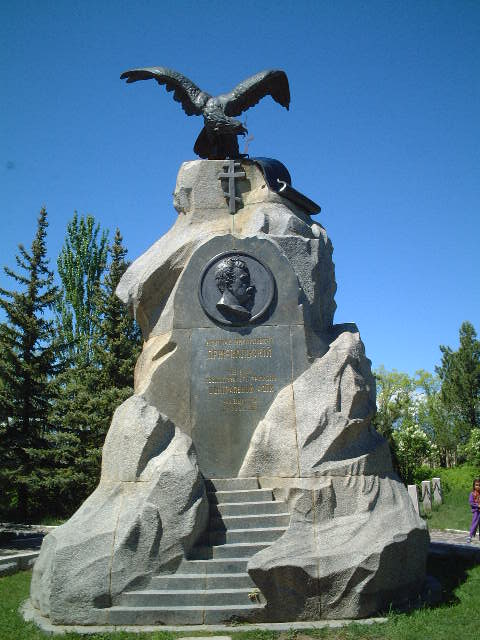
I eventually bailed out of Karakol without going hiking in the highest part of the Tien Shan. The weather was terrible; every morning I would wake up in my comfortable yurt to the sound of rain hitting the roof. After three days of lassitude and extreme sloth, punctuated only by a visit to the Przhevalsky Museum (a monument to the greatest Russian explorer of Central Asia, Nikolai Przhevalsky, one of my heroes), I decided that my time would be put to better use riding towards Bishkek and tilting at consular windmills there.

On Monday, I awoke to more rain, but by the time I had dragged myself from bed and loaded up the bike, it had stopped, and I didn't get rained on at all as I rode. I wanted to get to Bishkek, 380 km away, in 3 days, since that would give me 2 days to devote to chasing visas before the weekend. The first day, riding around the northern shore of Lake Issyk Kul, I rode 140 km to the old resort town of Cholpon Ata. It was a flat, easy ride, through agricultural villages where everyone was out planting potatoes and past yet more ancient Scythian burial mounds. I lunched atop one of the mounds, gazing out towards the lake and the clouds which (of course) hid the mountain peaks behind. I listened to the BBC news on my shortwave radio and contemplated local history.

Issyk Kul was an important area in ancient times because it provides a rare expanse of flat land in a very rugged area, and because the lake moderates the extreme continental seasons of the rest of the region. The lake doesn't freeze in the winter, and it maintains a pleasant warmth in mid-summer while Bishkek bakes in the high 30s. The Scythians loved the area, burying many of their kings and chieftains, along with their gold, in large earth mounds along the north shore. The Western Turks, the great power of Central Asia in the 6th and 7th centuries AD, made it the site of their summer court, and Xuan Zang, the greatest Chinese traveller, visited them by the lake in 630 AD, just before the first Chinese Tang Emperor invaded and destroyed the Turkish state.

I spent the afternoon racing along the road through more villages and then past a series of Soviet-era sanatoria and beach hotels which line the shore near Cholpon Ata. It had the feel of any beach resort area out of season: closed restaurants and deserted hotels.

It was getting late by the time I pulled into town, and I was just wondering where I would find a hotel when a car pulled up beside me and the driver asked me where I was planning to sleep. When I said that I didn't know, he told me to follow him. I figured he probably rented out rooms in his apartment, and it would be cheaper than a hotel, so I pedalled after him, gamely trying to keep up. I became a bit concerned when he kept driving right through Cholpon Ata and out the other side, but we eventually reached a comfortable house in the next village. Aleksandr, my host, was a retired architect who in his youth loved bicycle touring and had ridden throughout Kyrgyzstan and neighbouring Kazakhstan. He was a wonderful host, feeding me vast quantities of great food, plying me with home-made wine and telling me stories of the history and culture of the Issyk Kul area and of his own adventures sailing the lake on a schooner he had built himself.
He convinced me to take the following morning off and come sightseeing with him, but sadly he received a phone call at 4 am announcing the death of an old friend and had to depart immediately. I got up, ready to inspect the local petroglyphs before beetling off towards Bishkek, and discovered that my prized shortwave radio was gone. Thinking back, I realized that I must have left it as an offering for the dead Scythians at lunchtime, and I decided that I would have to go back for it. I left my bike at Aleksandr's house and took a bus 90 km back down the road, remembering why I hate buses as my knees complained vociferously about being wedged into tiny spaces between the seats. After two hours I stopped the bus in the middle of nowhere, to the great surprise of the driver, and leapt out to run to the Scythian mound. My radio lay just where I had left it, hidden in the grass, but unfortunately I couldn't remember exactly where I had been sitting, and it was an anxious quarter of an hour before I saw it glint in the sun. The ride back to town was enlivened by a surprisingly good Hong Kong kung fu flick, and before I knew it I was back at Aleksandr's house.

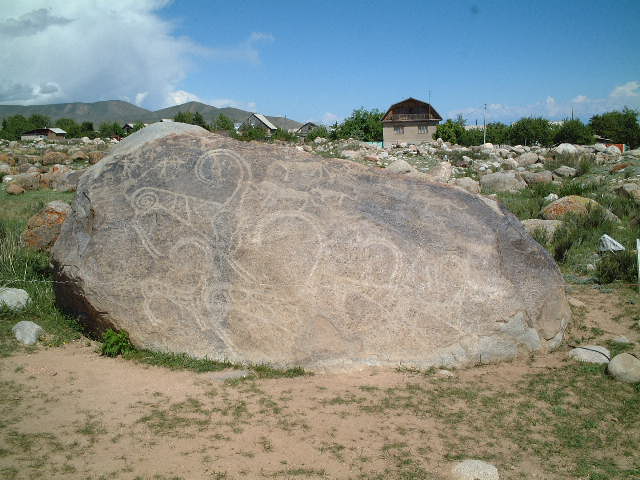
His wife insisted on a lavish lunch before I set off, and I couldn't refuse more free food. Then I had to check out the local petroglyphs, 2000-year-old carvings (done by--who else?--the Scythians) of hunting scenes involving Marco Polo sheep, snow leopards, camels and horses which were pointed out to me by a posse of ten-year-old boys. I left town by an unusual route, racing downhill from the petroglyphs at insane speed along a disused airport runway, waiting for my bike to sprout wings so that I could make up all the hours I'd spent retrieving the radio. I rode hard during the few hours of sunlight left to me, through increasingly arid land, as the lake began to narrow and 4000-metre peaks, finally shedding their clouds, closed in around me. I rode into the desolate post-Soviet industrial hellhole of Balkychy around sunset, dodging begging children, belligerent drunks and malevolent dogs as I headed for the canyon leading downhill towards the capital. Gale-force winds reduced progress to a crawl and I found a sheltered ravine to pitch my tent for the night.

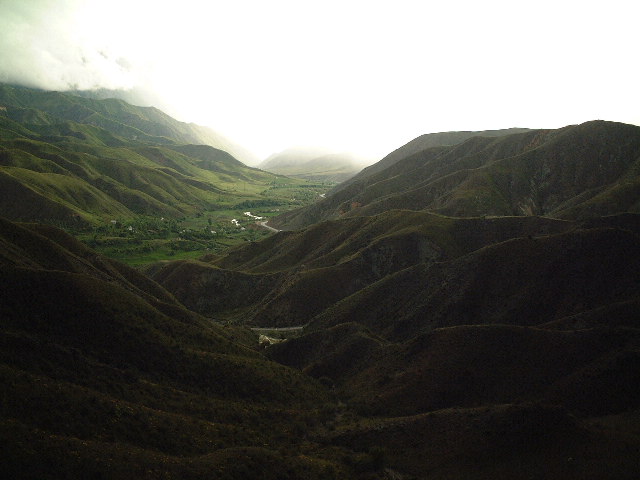
The next day I had hoped to reach Bishkek, aided by a 1000-metre drop in elevation, but instead I suffered through the most disappointing cycling of the trip so far. It was payback for the insane tailwinds which blew me down to the Kazakh border from Sairam Lake, as howling headwinds tried to blow me right back to Cholpon Ata. My progress was slowed to a sad 10 km/h even on the steepest downhill bits, and I slowly lost all enthusiasm for continuing the struggle. The scenery was pretty, with eroded red canyons beside the road and, as the river descended, luminescent green mountain pastures above it. It took 5 hours to get out of the canyon and into the plain of the Chuy River leading to Bishkek. Once I was in the lowlands, the wind abated a bit and the lines of roadside poplars provided some shelter, and I was able to resume more normal cycling speeds.

I made it to Tokmak, still some 60 kilometres from Bishkek, and settled into a roadside cafe to fill my empty stomach with kebabs, noodles and beer, the high-octane fuel of choice for cycle tourists. I was amazed at Aleksandr's story of having once cycled the entire 240 kilometres from Cholpon Ata to Bishkek in a single day, on dirt roads, on a 3-speed. He must not have had the headwinds I had, or else he was a real Lance Armstrong in his youth. While I was lamenting the sad state of my cycling prowess, the Kyrgyz men at the next table struck up a conversation with me, and before I knew it, I had joined their friend's birthday party, with numerous vodka toasts to his health. They delivered me to a local hotel and then took me on to a banquet hall for more toasts before I called it quits, pleading that I had to ride a bike to Bishkek the next day. They were an interesting crowd of dubious biznesmen wheelers and dealers, with nicknames like Michael Corleone and The Doctor. One of them looked very Italian, and I found out that he was a Chechen, one of the hundreds of thousands deported by Stalin to Central Asia during WWII, whose family had opted to stay in Tokmok rather than return to the Caucasus in the 1950s after Stalin's unlamented demise.

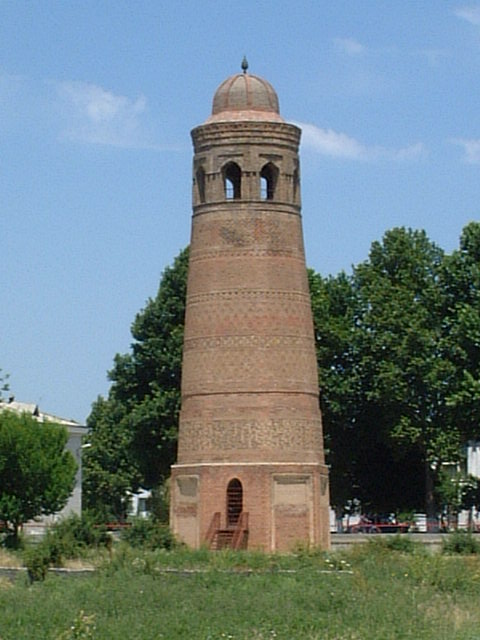
The next morning it was difficult to tear myself from bed and face the bike, and I was glad that I hadn't continued any later with the vodka toasts. I rode off slowly to Burana Tower, a local historical site, and spent a couple of hours pottering around inspecting the restored brick minaret, the collection of shamanistic carved human figures and the local museum, accompanied by a grade 7 class from Tokmok who adopted me, chattering away with excited questions and begging to have their pictures taken. I ordinarily dislike having self-appointed guides showing me around, but these kids were so excited and so much fun that I really enjoyed my time with them. Their teacher was pretty happy as well that they got a chance to practice their few words of English with me, and I had to promise to send them a postcard from Tajikistan when I got there.

The ride into Bishkek was uneventful: flat, busy, easy and somewhat hampered by an overwhelming desire to pull into a field and have a nap. As I pedalled, I noticed how many of the local villagers looked Chechen, their sharp features and Mediterranean faces contrasting with the local Russians and Kyrgyz. Before I knew it, I was in the capital, trying to make sense of a map that bore no resemblance to the reality of the streets. I eventually figured out that although the street names had been changed since Soviet times, no-one had bothered to change the actual street signs, so that my modern map bore names that didn't appear anywhere in the city. I rode past my guesthouse three times before a helpful policeman showed me the unmarked door.

In Sabyr's Place, a rambling house next to the Russian embassy, I have found a little oasis of culture and good humour. Sabyr is another architect, with brothers who are painters and sculptors, and he edits a prominent arts magazine. The cast of fellow travellers is entertaining, particularly the first bicycle tourist I have met this year. Antoine has just shaved off his beard to look respectable for consular officials, and the long sideburns he left make him look extraordinarily like the great Russian poet Pushkin, so much so that strangers call to him across the street "Hey Pushkin!", and are disconcerted to find that he doesn't speak a word of Russian.

Yesterday I spent at the Uzbek and Tajik embassies obtaining visas. I had heard horror stories from Antoine and others about the chaos at the Uzbek embassy, but as it turned out, everything went smoothly; I dropped off my passport at noon and was told to come back at 3:00 to retrieve it. In the meantime, I set off to search for the Tajik embassy, a non-trivial task as it wasn't in the Lonely Planet guidebook and nobody seemed to have heard of it. Finally the Dutch consul, whose office I stumbled across in my search, took pity on me and had his staff find the address for me. I rode my bike out into a distant suburb and knocked on the embassy door. To my surprise, I was ushered in and was able to start the process of applying for my visa even without having my passport in hand. I scampered back to the Uzbeks, got my passport back with an impressive full-page visa stamp and rode back to the Tajiks to drop off the passport. By 10 am Monday I should be ready to flee Bishkek and resume my Silk Road cycling peregrinations. Antoine may join me, at least as far as Osh, and it might be a nice change to have company along the road for a while. I have to be at the Tajik border south of Osh precisely on June 15th (I hate these restrictive Soviet-style visas which specify exactly what day I have to enter and exit the country!), and 2 weeks should leave me plenty of time for sightseeing along the way. I hope that if I have extra days at the end, I can spend them at Pik Lenin basecamp, dreaming of climbing this 7000-metre Pamir giant some summer soon.

I hope that everyone is well and is enjoying the approach of summer (at least those of you in the northern hemisphere). Stay well and have fun.

Carpe Diem

Graydon


Silk Road Ride, 2004: Part 5 (Pedalling with Pushkin)


Osh, Kyrgyzstan, June 11

2297 km from Urumqi

5850 km from Xian

I am up past my bedtime on a night before riding, but it may be the last time I see e-mail for quite some time, so I'm going to write a brief summary of the past 9 days of riding from Bishkek to Osh. I'm full of borshch, beer, bread and kebabs, the four major food groups of Central Asian travellers, so I'll be full of energy for typing this evening.

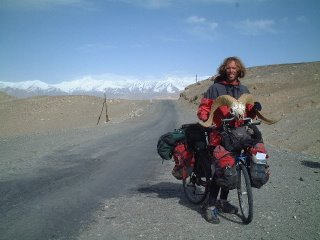
After 5 days of delicious indolent sloth in Bishkek, waiting for visas and permits, Antoine (aka Pushkin for his long sideburns and Pushkinesque face) and I rolled out of the capital last Wednesday afternoon. It was tough to tear ourselves away from the European ambience and sensational beauties of Bishkek, but the road was calling us. We rode 50 flat kilometres out of town and camped in some farm fields, lulled to sleep by croaking frogs.

The next day saw us start up the first really serious climb of the trip, from an altitude of 700 metres to a pass at 3700 metres. We climbed all day up a desolate rocky gorge, and gave up the struggle 80 km from where we had started but still well below the top. It was a long, hard day, but it felt good to have put most of the climb behind us.

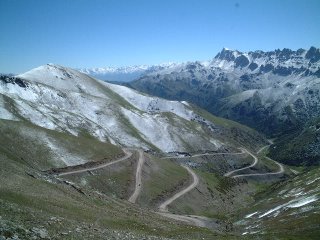
We awoke refreshed after a night camped beside a rushing trout-filled stream and continued the struggle, peering far up the mountainside to pick out our upcoming route. Coming around a hairpin bend near the top, we met four American Peace Corps volunteers whose chartered taxi had broken down, and had a long conversation with them before pushing onwards and upwards, through luxurious grassy meadows, to the mouth of the tunnel which has recently replaced the road over the pass. We donned headlamps and reflectors and set off into the maw of darkness. When we emerged on the other side, the world had changed. Gone were the steep rocky defiles of the north side of the range, in favour of open, gentle grassy slopes rolling down to a flat, broad, high-altitude valley. We flew down in spasms of gravitional giddiness (up to 65 km/h) and had a memorable lunch break on a green hillside carpeted with wildflowers, watching the tiny sheep far below and the snow-capped peaks beyond. When we finally hit the bottom, we zipped up the valley to an exquisite campsite beside a rushing stream; only the clouds of voracious mosquitoes spoiled the bucolic perfection of the spot.

Another pass awaited us the next morning, but this was a gentler proposition than the first one, and we crossed the broad, boggy top, only a few days removed from winter snows, in early afternoon. The descent was one of the best of my cycling life, an endless series of mountain vistas reminiscent of the Italian Alps, each bend of the valley revealing a yet more perfect scene. The river boiled beside us in an unbroken series of whitewater rapids, and roadside stands sold honey and trout. It was sad to leave the gorge after 60 unforgettable kilometres and emerge into the drab town of Toktogul. We took a page from Antoine's playbook and asked a farmer for permission to camp in his yard; they were very hospitable and fed us a lavish breakfast the next morning, but they woke up loudly at 6 am and made it difficult to complete our beauty sleep.

We spent the entire next day circling Lake Toktogul, a hydro reservoir, drenched by a never-ending series of rainshowers, each more violent than the last, and tired by an equally infinite series of sharp uphills and downhills. The final instalment of precipitation was a frightening hailstorm which pummelled us on the final mini-pass of the day and sent us scurrying for shelter at another farmhouse where the hospitality was just as warm but the people got up even earlier. Bleary-eyed, I made Antoine promise that we would henceforth camp somewhere secluded by ourselves.

We had another lovely downhill in the morning, punctuated by a much-needed swim and me breaking my drum brake cable--twice. I finally figured out what was wrong, and did some metalwork to repair a bend retaining arm. We lunched sumptuously on river trout, and emerged ready for a big afternoon, only to be foiled by a road closed for repairs. We sneaked through after an hour, almost losing Antoine along the way to a huge boulder rolling down from above, and had another frustrating roller coaster afternoon around not one but four separate hydro reservoirs. The day was redeemed, however, by the best campsite of the trip, on a rocky headland projecting into the last reservoir. The surroundings looked Aegean, and we swam in the last light of afternoon before cooking and then watching a spectacular lightning storm over the mountains we had just left. We took time-lapse photos, and I sat outside watching the light show and playing guitar in one of the most relaxed, yet invigorating, evenings of the trip.

From that point on we dropped out of the high mountains into the relative lowlands of the Ferghana Valley. Warm, fertile and settled by agricultural societies for the past 3000 years, the Ferghana is a world apart from the rest of Kyrgyzstan. For one thing, the people mostly speak Uzbek, and many of them are ethnically Persian, with sharp Indo-European features instead of the broad, smooth Mongolian faces of the Kyrgyz. I felt as though I had left behind Europe and returned to the Asia I know, the rice fields of South-East Asia and the farming villages of central India. Even the birds were old friends, the Indian rollers and bee-eaters that had kept me company on previous trips in South and South-East Asia. The scenery became unremarkable, dun-coloured hills surrounding flat, fat farmland, with the mountains receding far into the distance.

The borders of Central Asia are all artificial, products of Stalin's ethnic divide-and-conquer strategy, but nowhere are they as farcical as in the Ferghana Valley. Uzbekistan controls most of the lowlands, with the Uzbek-Kyrgyz border extending narrow fingers of Uzbek valley into the Kyrgyz hills. It gets even sillier to the south, where three tiny enclaves, two Uzbek and one Tajik, are surrounded on all sides by Kyrgyz territory. The convoluted fractal boundaries make travel a pain, as roads take long unmarked detours to avoid crossing into Uzbek valleys. We zigged and zagged and cursed the horrible road surface, but made good progress towards Jalalabad until the moment when we stopped to phone the Iranian embassy in Bishkek about Antoine's visa. While he struggled with the intricacies of Kyrgyz Telekom, I faced a curious mob of 100 or so people, answering questions about my name, my marital status, why I don't have children and who is sponsoring the bike trip (nobody believes that I could possibly want to do this just out of interest). When it came time to depart, Antoine's derailleur suddenly exploded into a mass of twisted metal and ruined chain. It took two hours of work to fix the mess, aided by a nearby auto body shop, during which time I was the star and backdrop of several rolls of film: Graydon with his bike, little Kyrgyz kids on Graydon's bike, Graydon on horseback in a Kyrgyz felt hat, Graydon surrounded by entire families....We were glad to escape from Massi and camp in a stand of poplar trees.

I was awoken the next morning by the insistent mooing of cows and the frantic screams of their 7-year-old herders. Antoine must have awoken to the same sounds, since I soon heard a howl of "Ta gueule!!" (ie, shut up!) from his tent. We had a relaxed ride into Jalalabad that morning, although Antoine found the final climb taxing and decided that he needed some time off the bike. He headed off to Bishkek that afternoon by shared taxi to pick up his Iranian visa, and I haven't seen him since, as he was delayed by mechanical and bureaucratic gremlins; I hope he shows up tomorrow morning!!

I spent a much-needed day off in complete lethargy in Jalalabad, stopping eating only to bike up to the hilltop sanatorium overlooking town. I had visions of Japanese rotenburo open-air hot pools lined with artfully arranged rocks. What I found instead was a decaying Soviet-era disaster. You would think that in an institution which owes its very existence to hot springs, it would take less than 40 minutes to find hot water. In the end I was escorted into the bowels of a huge condemned building to a once-white enamel tub where I took a bath, surrounded by the rusting, dripping, moulding remnants of plumbing. I should have remembered that there are two words which can reduce even the hardiest traveller to gibbering incoherent fear: Communist plumbing.

On a more positive note, I spent much of my time in Jalalabad socializing with the local Peace Corps volunteers, a diverse, interesting group full of information and gossip on the state of Kyrgyzstan. They filled me in on the local custom of bride-napping (many, many marriages in Kyrgyzstan are still arranged this way), the extraordinary wealth of the governor of Naryn province (the poorest part of Kyrgyzstan) and relations between the genders in the country.

Today I finally managed to leave early, and had a relaxed, if hot, roll around another corner of Uzbekistan (it added 60 km to the distance), via the town of Ozgon and its 11th-century mosque and mausolea, ancestors of the Moghul style of the Taj Mahal. I spent a happy hour sketching and photographing before sweating my way along the worst roads of the trip, 55 km of bombed-out, corrugated asphalt punctuated by brief stretches of washed-out gravel, into Osh.

I will await Antoine here tomorrow morning before beginning a voyage into the almost-unknown: the Pamir Highway through Tajikistan. Everyone here who hears that I'm off to Tajikistan tells me that I'm as good as dead, if not from rebels then from heroin smugglers coming from Afghanistan. I can't wait to see the huge peaks of the Pamirs, though, and I'm sure that the warnings about Tajikistan will prove as ill-founded as the dire predictions of robbery and death I received about Kazakhstan.

I'll keep you all posted on how the Bam-i-Dunya, the Roof of the World, goes the next time I see e-mail, likely in Dushanbe in 2 or 3 weeks. Until then, be good, have fun and carpe diem!

Cheers

Graydon


Silk Road Ride, 2004: Part 6 (Pedalling the Pamirs)


Dushanbe, Tajikistan

July 8th

3750 km from Urumqi

It's a strange feeling to be sitting in a modern Internet cafe with a full belly after a hungry month spent in some of the poorest, most remote country I have ever been in. It's been a tough, eye-opening, unforgettable ride through the remote Pamir Plateau and along the long Tajik-Afghan frontier, and I have to say that I'm enjoying taking a couple of days off the bike to eat, relax and sleep.

When I last wrote a month ago, I was in Jalalabad. After a day off there, punctuated by a visit to the very archetype of a decaying Soviet hot-spring sanatorium, I rode to Osh, the second-largest city in Kyrgyzstan. Because of the ridiculously convoluted nature of the border with Uzbekistan, rather than 40 flat kilometres as it would have been in Soviet times, the ride was 110 undulating kilometres long. I stopped halfway to see some 11th-century Muslim mausolea in Ozgon, the first really impressive old architecture I've seen since Urumqi. Osh was big and clamourous and full of good food. I spent a great deal of time in the big open-air food court opposite my hotel, filling my belly with kebabs and borshch against the lean times ahead. I was still waiting for Antoine to reappear from his visa run to Bishkek; he was 2 days late in returning. While waiting, I treated myself to a haircut, which was an amusing experience, with the barber constantly sending for items from the women's hair salon upstairs. The final results weren't too bad, and, at $1, neither was the price. I checked my e-mail again and read that Antoine had arrived in Osh and cycled off down the road looking for me. I set off in hot pursuit, only to discover that nobody along the road had seen him. 60 kilometres down the road he passed me as a passenger in a truck which then refused to stop and let him out. We didn't find each other until mid-morning the next day.
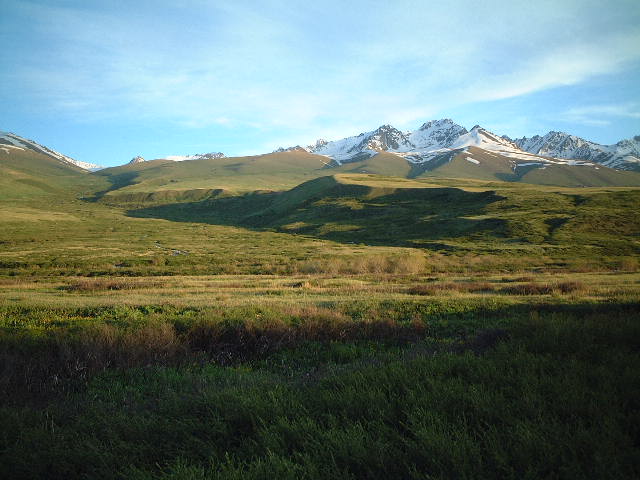
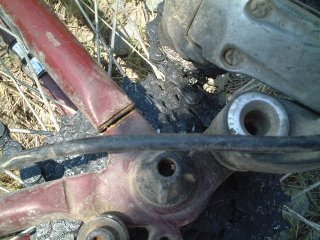
The ride south from Osh was through the northern outliers of the Pamir mountains, over a couple of high passes. The riding was enjoyable, and the scenery was impressive, but on the third day out of Osh, I made an unwelcome discovery. My rear wheel began wobbling badly, and when I investigated, I discovered that the frame of my bike, worn out by 19,000 kilometres of hard riding, had snapped beside the back axle. I was unhappy, but I had bought a bike made of steel rather than aluminum at least partly because steel can easily be welded together again if it breaks, so I knew that all I needed to find was a welder. By sheer chance, when I stopped a passing car, he was going to a nearby village off the main road where there was the only welder between myself and the Tajik border. I piled into his Lada and in an anxious half hour, the bike was in one piece again, reinforced by an extra steel plate, and the future of my bike odyssey was rosy again.

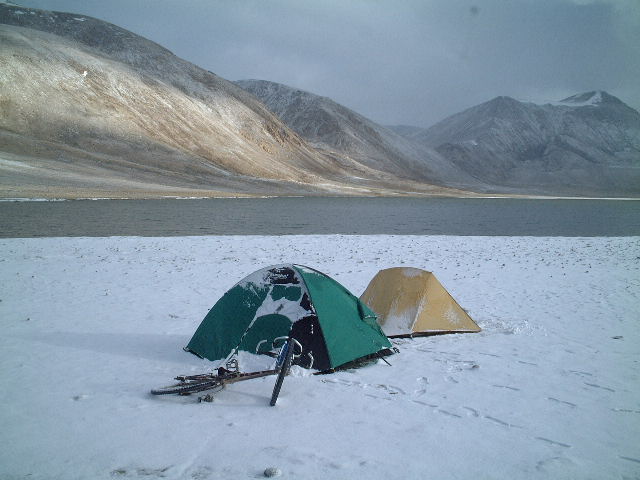
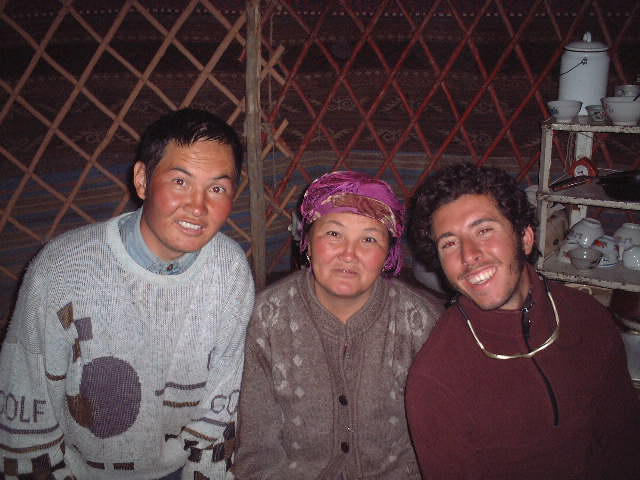
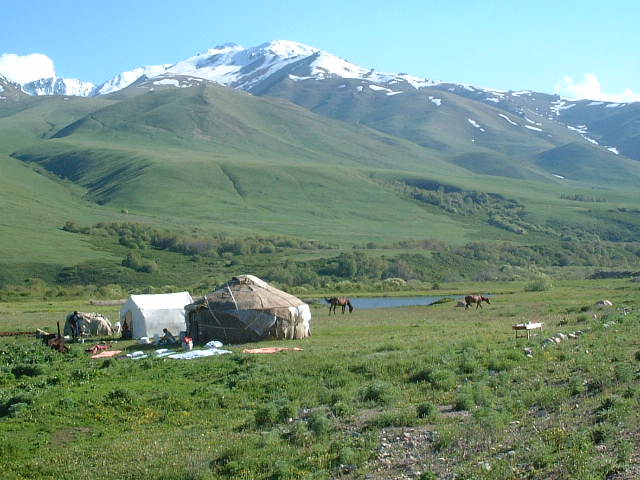
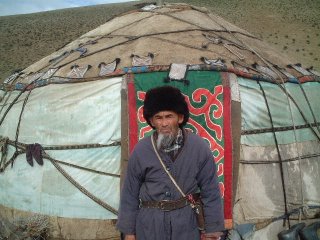
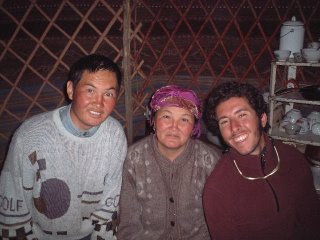
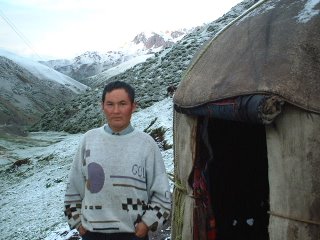
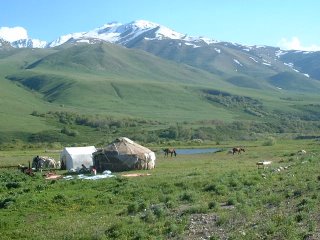
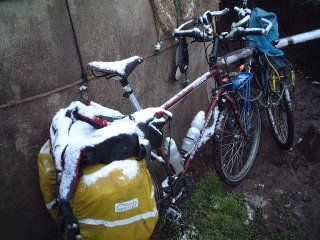
That afternoon, as Antoine and I slogged uphill to a 3600-metre pass, the weather, which had been spitting for a couple of hours, settled into steady rain which got colder as we gained altitude. At the foot of the final climb, it turned to snow and we decided to seek shelter, chilled to the bone, in a nearby yurt. We spent the night snug and warm in this quintessentially Central Asian felt tent, fed endless cups of tea by the mother and son who were inhabiting the yurt for the summer as they grazed the family flocks on the high pastures. We had an evening of interesting discussions on the role of bribery in Kyrgyzstan (epidemic at all levels, especially in education), bride-stealing (a common way to get around paying high bride-prices, by kidnapping the bride-to-be and negotiating from a position of strength) and, inevitably, the lament that "things were better back in Soviet times". As we drifted off to sleep, the mother asked Antoine and I why we aren't married, and cackled that she would find us both Kyrgyz brides.

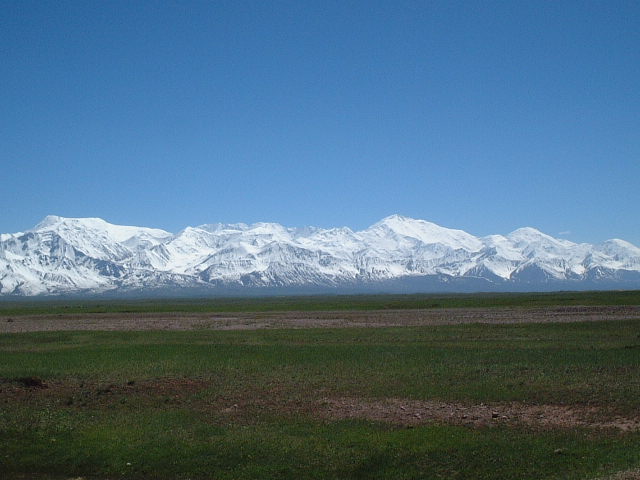
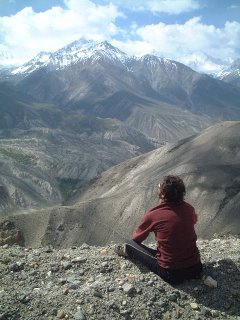
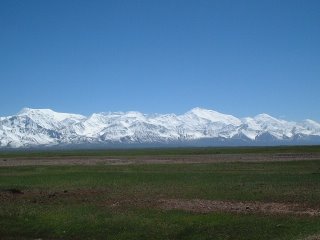
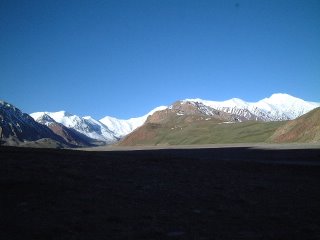
The next day, my last in Kyrgyzstan, was easily the most disappointing of my stay. We crawled over the top of the pass in brilliant sunshine, surrounded on all sides by snowy peaks, and descended briefly into the high-altitude Pamir Alay valley, a broad green swath between the mountains we had just crossed and the wall of monstrous 6500-metre peaks to the south dominated by 7000-metre Peak Lenin. To the east the valley leads, over a couple of easy passes, to Kashgar, China, while to the west the direct road to Dushanbe stretches arrow-straight to the horizon. We rolled into Sary Tash, the last village in Kyrgyzstan, in a happy mood, stopping frequently for photos of the dazzling white glaciers in front of us.

We wanted to do only a few things in Sary Tash: eat well, buy some extra food supplies and change our leftover Kyrgyz som into Tajik somoni. None of these things really occurred. The town's three cafes were almost bereft of food, and there was nothing to buy except vodka, which the entire local population had been hammering back all morning. I had two aggressive drunks try to pick fights with me, the local kids (several of whom seemed to have been sniffing gasoline) threw rocks at us and someone stole my wallet (which, luckily, contained only $0.30 in local currency at the time). We left before things turned into a full-scale brawl and headed across the Alay valley, past dozens of huge golden eagles quartering the grasslands for rodent tidbits, to the Kyrgyz immigration post. There, it was a repeat of Sary Tash. The border garrison were out playing volleyball and toasting each point with vodka. The two soberest officers decided that my visa was not in order: "Shee, it shays good until the 15th; you're too late!" "But it's the 15th today." "That's what we mean; you're too late." And so on for 2 interminable hours. We were clearly in the right, but it's hard to argue with a lot of armed drunks looking for bribes. The situation was saved by the Euro 2004 soccer tournament; everyone wanted to go back to Sary Tash to watch the game, and they couldn't just leave us sitting there, so they finally sent us on our way at dusk. We camped in a shimmering meadow alive with wildflowers, wondering what Tajikistan would be like.

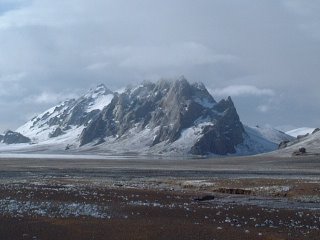
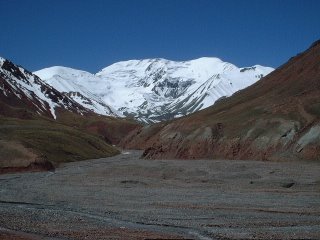
The next day we crawled uphill over a 4200-metre pass, the Kyzyl-Art, into a new world. Gone were the greens and the life of the Kyrgyz mountains. Instead, after a long session of tea and bread at the Tajik immigration post, we bumped downhill into a passable imitation of Mars: not a blade of vegetation or a drop of water to be seen. The road, the 1930s-era Pamir Highway built by the Soviets, was empty; we saw 2 vehicles that day, and camped beside the deserted road feeling very, very insignificant in the vast landscape.

For several days we crawled south to the first town, Murgab. The views would have been spectacular if it hadn't been so cloudy and grey all the time, punctuated by rain and hail. For a region which looked so arid, it certainly rained a lot. Having brought rain to the Sahara and the Atacama deserts in the past, I seemed to be strengthening my credentials as a rain god. The landscape was almost entirely empty of human life until we got near Murghab. The Eastern Pamirs are inhabited by 15,000 Kyrgyz nomads, half of whom live in Murghab and the rest of whom live in the broad, flat valleys between the barren brown mountains. It reminded me a great deal of Western Tibet, although not quite as grand and open and impressive, althought that may have just been the grey weather. In particular Lake Karakul, which is said to be absolutely spectacular, looked very subdued in mist and rain.

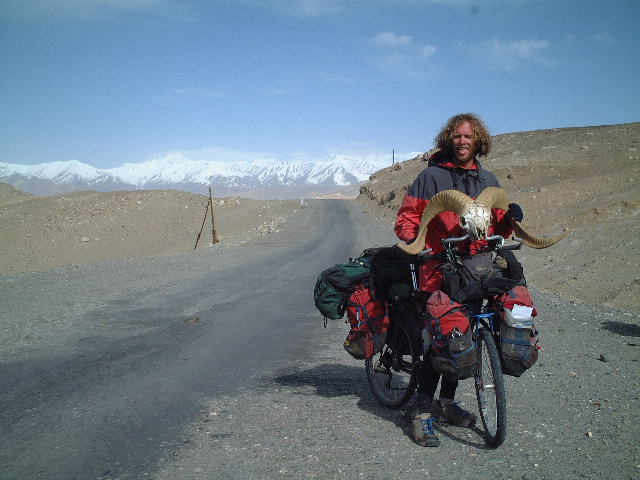
In Murghab we waited for 2 days for our border zone permit, an arcane piece of Soviet-era movement control, before setting off into the rain. We decided to strike off into the remoter corners of the Pamirs, trying to reach Lake Zorkul, the source of the Oxus, by a back road. We started off well on a dirt track leading to a hunting camp where well-heeled Americans come to shoot endangered Marco Polo sheep. (The locals poach plenty of them too, borrowing automatic weapons from the border guards and selling the meat at half the price of yak meat or mutton; a tasty stew we had at Karakul turned out, afterwards, to be Marco Polo sheep, not yak.) The inevitable snow and hail came, though, turning the track into a quagmire. The next morning we ventured further, but finding a couple of Dushanbe expatriates in a jeep irremediably augured into the mud at a river crossing convinced us that the road was only going to get worse, and we fled back to the main road the following morning.

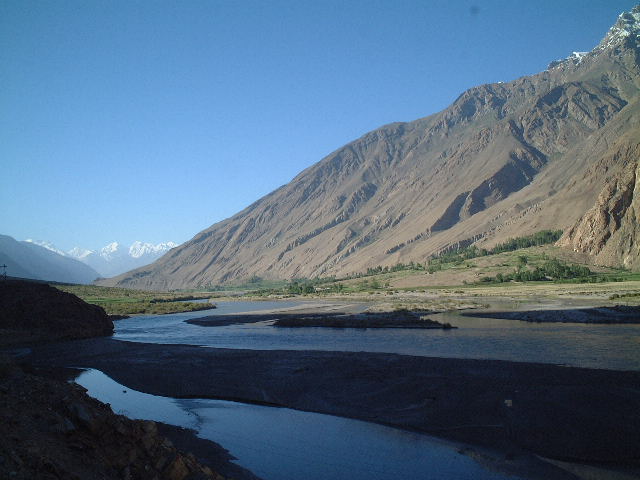
For a couple of days we rolled through slightly more populated country, the flat boggy Pamir valleys dotted with Kyrgyz yurts, before striking off again onto a secondary road for the Afghan border. We bumped along a lamentable dirt road to a 4000-metre pass and weathered a blizzard that night. We spent a couple of days descending very slowly along the Pamir river (the infant Oxus), watching Afghanistan roll past us on the opposite bank a stone's throw away. (I pitched a couple of rocks across the river into Afghanistan just to show it could be done.) The weather continued to be miserable, and we spent the night in an abandoned road maintenance house, listening to the gale outside try to blow us back to the pass. In the morning, shaggy Bactrian camels were roaming the Afghan bank of the river, looking like a throwback to the days of the Silk Road

When we finally dropped into flat country at the junction of the Pamir and Wakhan rivers, we thought that our troubles were over. The weather was warmer, and there were villages strung densely along the river. We were on a major ancient trading route along which Marco Polo himself had come, and old forts and Buddhist monasteries lay in ruins along the river. Instead, when we asked in the first town, Langar, where we could find a cafe, we were told "not here." A store selling food? "Nope." Gasoline? "Maybe 15 kilometres down the road?" For several days, on the worst roads we'd seen yet, rutted gravel traps interspersed with sand dunes or boulder fields, it was the same story: no food, no gasoline (our camping stoves were running empty), no cafes. It was the most cash-poor place I'd been in years, poorer even than most of Tibet; everyone was a subsistence farmer, with no money to spend, and hence no shops or bazaars in which to spend it. People live on black tea and bread and nothing else; hardly a diet to subsist on, let alone ride a bike on. We resorted to asking random farmers if they had any bread to sell us, as otherwise we would have starved. Even the flour for the bed is largely a handout from the World Food Program; truly, this corner of Tajikistan makes most of Africa look rich. It's a measure of how poor Afghanistan is that the Tajiks we talked to said that it was a pity that life was so much rougher over on the Afghan side of the border.

Things began to look up as we approached the town of Ishkashim. One hungry morning, we stopped in a small village and found, wonder of wonders, a cafe. We went in and ordered a dozen fried eggs, bread and whatever else the owner could find to feed us. We had eaten and were just contemplating leaving when four drunks walked in. One of them introduced himself as a cop and demanded to see our papers. Another endless argument ensued, as he tried to convince us that our border permit was not in order (it was) and that he was going to have to arrest us. I impressed myself first of all by being able to argue our case for 2 hours in Russian, and secondly by not losing my temper and throwing the idiot into the river, where he richly deserved to end up. The funny thing was that when he finally caved in and let us go, he sent all the spectators out of the room so that nobody would see him climb down. We saw him again two days later, past Ishkashim, sober and in uniform at a checkpoint, and he betrayed not a hint of recognition. I felt lucky that we, as foreigners, were able to stand up to this sort of official bullying. It must be tough if you're Tajik and have to live in the same village as this lout; if you stand up to him, you always have to worry that he'll exact some sort of revenge later.

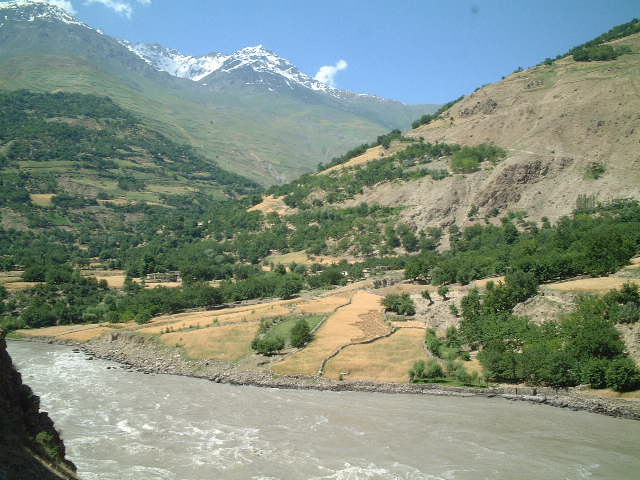
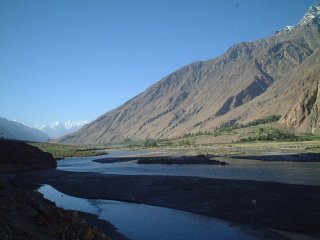
The miserable, slow, bumpy riding and empty stomachs were somewhat compensated by two things. First of all, on the Afghan side of the river, we could see the high, steep, ice-sculpted peaks of the HIndu Kush, marking the Afghan-Pakistani border; Afghanistan is only 20 kilometres or so wide at this point, the funny-looking finger of the Wakhan corridor which separates the former British and Russian empires from each other. I had seen these peaks before, in 1998, from the other side, and I had forgotten how dramatic they are, much more so than the older, rounder, gentler peaks of much of the Pamirs. Huge glaciers spill down steeply from them, practically right into the Pyanj River. The other nice thing about the area were the hot springs, a welcome place to warm up and get clean and relaxed after a tough day in the saddle.

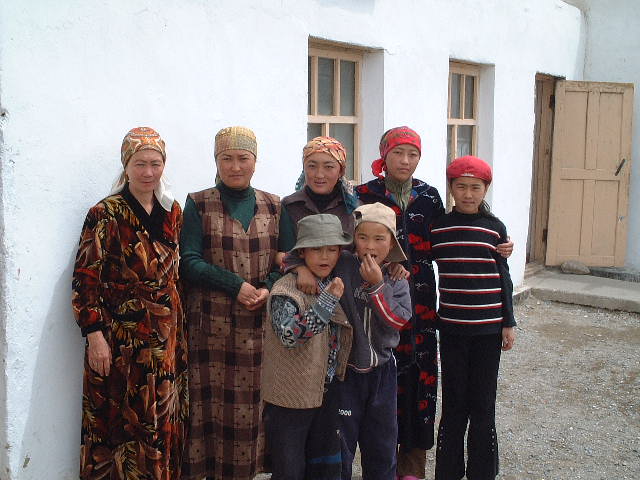
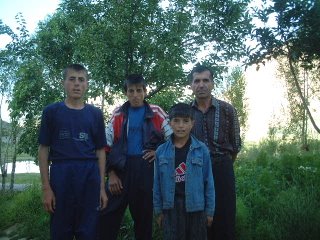
The people had changed when we dropped off the Pamir Plateau, from the Mongol-looking Kyrgyz to the European-looking Pamiri Tajiks. Ismaili Muslims, descendants of ancient Indo-Iranian tribes, the Pamiris would not look out of place in Greece or the Balkans, and indeed myth makes them the descendants of Alexander the Great's soldiers, although they've been in the area much longer than that. Each valley's people look distinctly different, and speak a completely different language. Some people looked very Indian, while other valleys were full of sandy-haired people who wouldn't have looked out of place in an English pub.

The ride to Ishkashim and on to Khorog was fairly uneventful, marked only by frequent encounters with Russian border guards. Much more professional than their Tajik counterparts, the Russians were deeply suspicious of what we were doing prowling around the Afghan frontier, but were mollified when all our papers were in order. They were also always sober when on duty, a welcome change.

In Khorog, we found cherry, apricot and mulberry trees bearing ripe fruit, and a bazaar worthy of the name. We thought that the hard part of our trip was over. Instead, the road deteriorated further after that point, making each day a dismal series of bumpy uphills and downhills, dodging potholes that could swallow a Lada. Once again the cash economy seemed to disappear, and the villages clinging to mountainsides grew poorer. We stayed in people's houses several times and discovered that this was the only way to eat well; none of this good food was available in stores or cafes. On the opposite bank of the Oxus, we could see the World Food Programme handing out free flour and men carrying 50-kg sacks of it dozens of kilometres along precipitous, death-defying trails hacked into the mountainsides.

No bike trip in Asia is complete without being arrested, and one day, coincidentally on Canada Day, at a (luckily) Russian checkpoint, we found that our border zone permit had expired the day before. It took 6 hours to sort out the mess, with us being sent to the district border garrison and then to the local visa office to extend our permits. It worked out well, though; we were fed twice, and a jeep took our luggage to the Vang garrison while we biked unencumbered by baggage for 25 kilometres. Even our endless wait for the permit to be extended was made bearable by the fact that the office was surrounded by cherry trees groaning under a load of ripe fruit, and we ended the day swimming in the garrison swimming hole.

Crossing the 3200-metre pass away from the Oxus, I fell ill with dysentery, making the crossing a slightly delirious, hazy experience. Antoine, ill as well, took a truck, and then jumped another one to get to Dushanbe and off this road of hopelessness as quickly as possible. Even the truck, though, took 2 days to make the final 200 km into the city, and he beat me into town by only 6 hours. I soldiered on, riding my bike over the worst roads I've ever seen outside of Tibet, before suddenly hitting asphalt 70 km from town and zipping into this oasis of properity in the desert of utter poverty that is Tajikistan.

I'm staying here with Monika (one of the expats we found stuck in the river near Murghab) and her husband Sebastian, in their comfortable house. After 2 months on the road, it's almost unimaginable luxury to have a real bathtub, a real toilet, a well-stocked refrigerator and a quiet, walled garden in which to relax. It will be very hard indeed to tear myself away and start pedalling the golden road to Samarkand tomorrow, when (if?) my Turkmen visa is ready, but I really have to start making progress if I'm to arrive in Iran before my Iranian visa expires on July 28th. From now on, the route will lie through more populated areas; the spirit of exploration and adventure will take a back seat to looking at historical monuments, but it's a change which my poor, tired, aching body will probably welcome.